

Invited to Bhutan Part 1: How a Devon Software Team Ended Up Advising a Himalayan Kingdom


This July, our Managing Director Henry Massey travelled to Bhutan with HRMNY, at the invitation of the country’s health and government leadership. This is the first of three articles about that trip: how it happened, what Bhutan is building, and what we found inside its hospitals.
Three weeks ago I was standing in Bhutan’s Parliament building in Thimphu, being introduced to the Prime Minister. A fortnight before that, I was at my desk in Exeter. This article is about the distance between those two sentences, and the partnership that made crossing it possible.
The invitation
The relationship in Bhutan belongs to HRMNY, the empathic technology company, and it was not built overnight. It rests on long-standing, trusted partnerships, nurtured with the help of Bhutanese members of the HRMNY team who understand the culture, the people and the country’s long-term vision, and on months of work with stakeholders to understand the healthcare challenges and shape a shared picture of what could be achieved. That foundation is the reason any of us were in those rooms.
My part sits within that wider effort. As HRMNY’s CTO, my role was to bring the technical architecture and engineering perspective, drawing on the experience of my software company, Exe Squared, which engineers the HRMNY platform. Together, the team combined strategic, healthcare and technical expertise to explore how modern digital infrastructure and AI could support Bhutan’s long-term vision for healthcare.
The platform itself is worth a sentence, because it completes the picture. HRMNY has built a broad assessment platform for health and care, designed to support, in time, every type of assessment across every care setting in the UK. One of its first successful deployments improves how Deprivation of Liberty Safeguards (DoLS) assessments are delivered: legally demanding assessments that protect people who lack the capacity to consent to their own care arrangements, and which are badly backlogged in much of the country. The platform improves their accuracy while reducing the time they take, and that combination, better and faster in a process that genuinely matters, is what every health system in the world is looking for. Add the talks I have given on the practical use of AI, and that is how the invitation came about.
Getting there
You cannot fly to Bhutan directly from Europe. I flew Heathrow to Delhi, slept in the transit hotel inside the terminal, and caught the midday Druk Air flight to Paro the next day.
That second flight deserves a paragraph of its own. Paro sits at around 2,200 metres, in a valley hemmed in by peaks that rise towards 5,500 metres. There is no radar approach. Pilots fly the final stages visually, in daylight only, threading the aircraft between ridgelines before a late turn onto a runway not much over two kilometres long. Only a small group of pilots, a few dozen worldwide, are certified to land there. It is regularly described as one of the most demanding commercial approaches in aviation, and having watched it from a window seat, I believe it. Hold that thought, because the same constraint reappears at the end of this story.


Paro Airport (our aeroplane, the terminal building and luggage collection)
A Sunday in Haa
Before any meetings, our hosts took us west to the Haa Valley, one of the most remote inhabited valleys in the country, hard against the border with Tibet. Haa was only opened to foreign visitors in 2002, and it still receives very few. Three hills stand over the valley, the Miri Punsum, the “Three Brothers”, said to embody the protective deities Jampelyang, Chana Dorji and Chenrezig.


The view from the road between Paro and Haa
At a small monastery we were invited to join a family purification ritual: the offering of a thousand butter lamps, lit one by one until the room was a single field of flame. It is a ceremony outsiders rarely see. Afterwards the monks fed us lunch: dried fish, dried beef, ribs and red rice, followed by chhurpi, the rock-hard local cheese that people chew and suck on through the day the way we might drink tea.
I have opened plenty of business relationships with a slide deck. I had never opened one with a thousand butter lamps. In Bhutan, trust comes before terms, and being included in something that personal said more than any contract could.
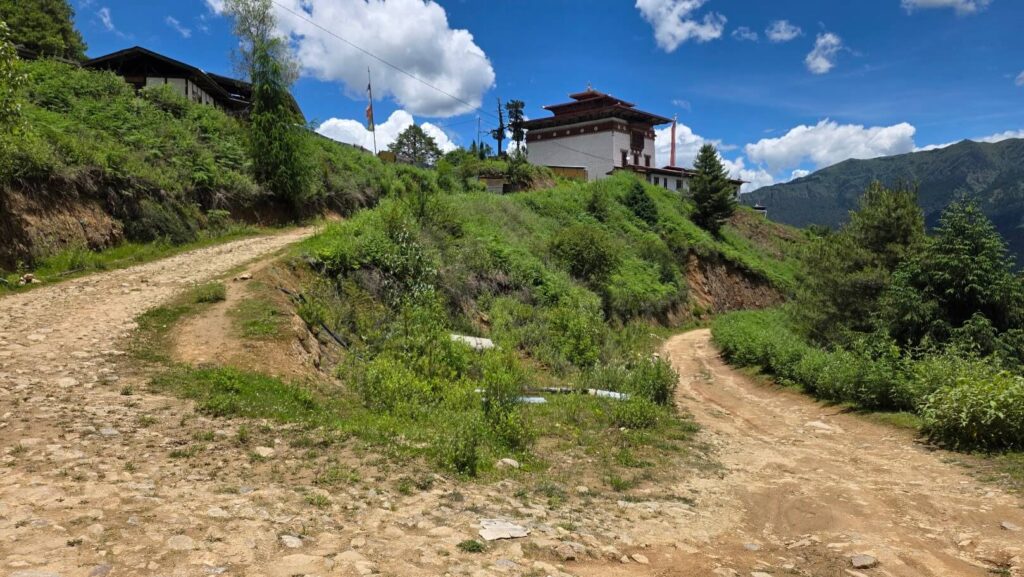


The journey to the monastery, in the ceremony and lunch
Thimphu, a capital unlike any other
The capital, Thimphu, rearranges your assumptions quickly. It is one of the only capital cities on Earth with no traffic lights: white-gloved police direct vehicles from ornate kiosks at the main junctions, and the story goes that when a set of lights was once installed, residents disliked it so much it was removed within days. There is not a single McDonald’s or Starbucks in the country. The food is gloriously, unapologetically hot: chillies are treated as a vegetable rather than a seasoning, usually smothered in cheese, and served with the nutty red rice that Bhutan grows at altitudes no other rice variety tolerates. Most meat is imported from India, because slaughterhouses are banned on Buddhist principle, one of many places where the country’s values are written directly into daily life.

The meetings
Monday was the working day: sessions with officials from government and the civil service about the state of the country’s health technology, which I will cover properly in part three. Later that week I gave a talk on the practical use of AI, drawing on what we have learned embedding it into real projects at Exe Squared, to a packed room. The questions afterwards ran long past the allotted time, and they were good questions: about data sovereignty, about clinical safety, about what AI genuinely changes and what it merely decorates.
Then came the meetings that made the trip remarkable. We spent two sessions with Dasho Dr Lotay Tshering, Bhutan’s former Prime Minister, a surgeon by training and now Governor of the Gelephu Mindfulness City project. And we were invited to Parliament, where our group met the current Prime Minister, Tshering Tobgay. Access like that is not won in a week. It reflects the years HRMNY has spent earning trust in Bhutan, and the months of joint work with stakeholders that came before the visit. Our job, as the engineering part of that team, was to be worthy of it: to listen carefully, understand the real problems, and bring back answers that stand up.
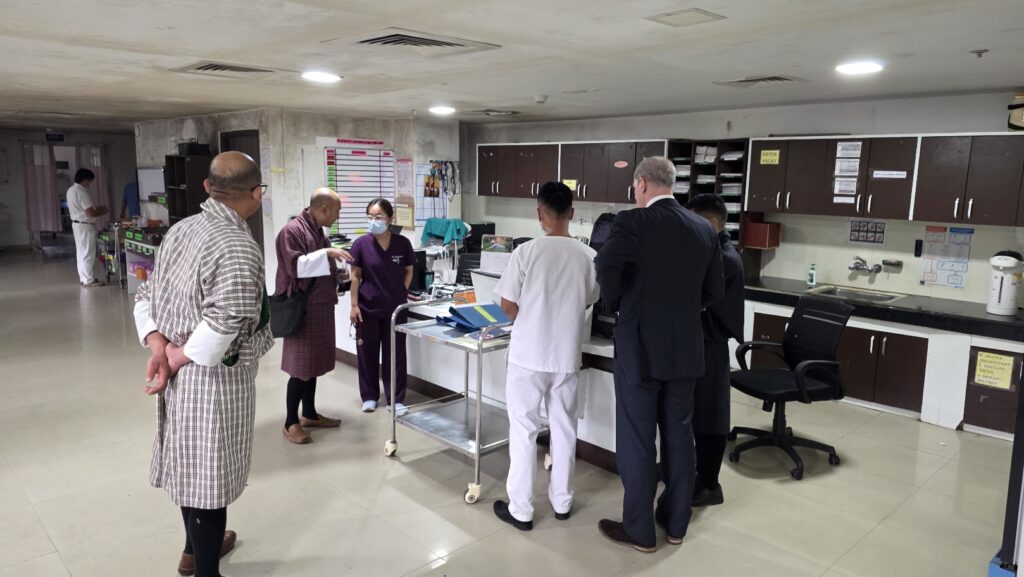


Within the hospital and meeting Dasho Dr Lotay Tshering, Bhutan’s former Prime Minister

A postscript from the cliff face
On the final day I climbed to the Tiger’s Nest, the monastery fixed impossibly to a cliff 900 metres above the Paro valley. Legend holds that Guru Rinpoche, who brought Buddhism to Bhutan, flew to the site on the back of a tigress and meditated there; the temple complex itself dates from 1692. The path climbs some 750 vertical metres at altitude, and it earns every one of them.
The next morning, our flight out was delayed two hours by low cloud. Remember the approach into Paro: if the pilots cannot see, nobody flies. It felt like a fitting last lesson from a country that works with its constraints rather than pretending they are not there.
What comes next
In part two, I will take you on the eight-hour drive south to Gelephu, where Bhutan is building an entirely new city, and explain why a nation of under a million people is attempting one of the boldest urban experiments in the world. In part three, we go inside the hospitals: what we found, the report we turned around in an afternoon, and where AI genuinely fits.
